Archive | September, 2011

Four Steps for Kids: Rear-Facing Car Seats

19 Sep

There are 2 types of car seats that are for rear-facing, infant carriers and convertible seats. Infant carriers typically have weight limits of 22, 30, and now 35 pounds. Convertible seats have rear facing weight limits of 30, 33, 35, and now 40 and 45 pounds.

Children should start rear-facing the day they come home from the hospital. The minimum by law in all states to stop rear-facing is 1 year AND 20 pounds. The child must meet both of these requirements, not one. However, a lot of child car seats available today have forward-facing minimums of 1 year and 22 pounds. At least one manufacturer, Dorel (they include the brands Cosco, Safety 1st, and Eddie Bauer) also has a minimum height requirement. This is why it is important to read and be familiar with the instruction manual for your child’s car seat.

However, best practice suggests otherwise. Safe Kids USA, NHTSA, and the American Academy of Pediatrics now recommend that all infants and toddlers should ride in a rear-facing child car seat until they are at least 2 years of age or until they reach the highest weight or height allowed by the manufacturer of their child car seat.  At age 2, if a child is still within the weight and height limits of their child car seat, they should remain rear facing until they reach those limits.

A common misunderstanding is that a child is ready to travel facing forward when his neck muscles are strong enough to support and control his head. However, crash dynamics show otherwise. Because the torso is restrained, the head is free to move around. The rigidity of the bones in the neck and strength of the connecting ligaments (not the muscles) hold the adult spine together and keep the spinal cord intact within the confines of the vertebral column. Very young children, however, have immature vertebrae that are still partly made of cartilage. These are soft and will deform and/or separate under tension, leaving just the spinal cord as the last link between the head and the torso. According to documented research, autopsy specimens of infant spines and ligaments allow for spinal column elongation of up to two inches, but the spinal cord ruptures if stretched more than 1/4 inch. Real-world experience has shown that a young child’s skull can be literally ripped from her spine by the force of a crash. (Refer to here for more info: http://www.carseat.org/Technical/tech_update.htm#rearfacFF) There are also some benefits to being rear-facing in a side impact crash.

Another common misconception is that a child should switch to forward-facing when their feet touch the vehicle seatback or the legs must be bent. There are no documented cases where a child’s legs have been injured because they were rear-facing. And even if there were cases, a broken leg is much easier to fix than a broken neck.

You may think no one rear-faces that long, but from personal experience, my oldest was rear-facing until the age of 2 and my second child rear-faced until age 2 1/2. You can see more pictures of kids rear-facing past the age of 1 in this album.

Here are some important things to remember when using a rear-facing car seat.

  • Never place a rear-facing car safety seat in the front seat of a vehicle that has an active front passenger air bag. If the air bag inflates, it will hit the back of the car safety seat, right where your baby’s head is, and could cause serious injury or death.
  • Make sure the harness is positioned at or below your child’s shoulders.
  • Since children grow in different proportions, it is important to know the height limit of the car seat, but it is also important to make sure that there is always at least 1″ of car seat shell above the child’s head.  This article shows how to check for the 1″.
  • If you are using a convertible seat for rear-facing, make sure the vehicle belt or LATCH strap is routed through the correct belt path of the seat.
  • Make sure the seat is at the correct angle so your infant’s head does not flop forward. Many seats have angle indicators or adjusters that can help prevent this. If your seat does not have an angle adjuster, tilt the car safety seat back by putting a rolled towel or other firm padding (such as a pool noodle) under the base near the point where the back and bottom of the vehicle seat meet. For small infants, the angle of recline should be 45 degrees. For older children, the seat can be more upright, to an angle of recline of 30 degrees.
  • If you child slouches in the seat, you may add things around the child, not behind the child, using things such as rolled up cloth diapers or receiving blankets. Do not use any sort of car safety seat insert unless it came with the seat or was made by the manufacturer of the seat.
  • Do not place an infant seat on the top of a shopping cart. It may seem like it clicks into place, but this is not how that locking mechanism on the seat is designed to be used. Plus, it changes the center of gravity of the shopping cart, which could make it easier to tip with just a bump. If you really want to keep the baby in the infant car seat, put the car seat in a travel system stroller and either pull a shopping cart while pushing the stroller or use the stroller basket to hold the items. Another option is to put the infant carrier in the main basket of the shopping cart and pile groceries around the carrier. Yet another option is to take your baby out of their car seat and put them in a sling or other baby carrier.

National Child Passenger Safety Week Sept 18 – 24, 2011

18 Sep

After the birth of my first daughter, I really started researching child car seats and safety in the car. I found there was a ton of information out there, most I had never heard of before. It motivated me to research what I could and share the information with other parents. I took the week-long class and became a certified Child Passenger Safety Technician (CPST) in October 2008.  In April of 2010, I became a Child Passenger Safety Technician Instructor (CPST-I).

Last week, Safe Kids USA released a new study they just completed.  They analyzed data from 79,000 child car seat checklist forms that were completed by Safe Kids coalitions at child safety seat checks around the country. Previously, the National Highway Traffic Safety Administration has done research that shows three out of four child safety seats are improperly installed.  The new Safe Kids research says that this percentage has improved slightly, but there is still room for more improvement considering car crashes remain as the leading cause of death in children ages 3 – 14.

Today, I would like to share some general car seat information and over the next few days, I will share specific information for each of NHTSA’s Four Steps for Kids, rear-facing, forward-facing, booster, and seat belt.  At the end of the week, Saturday, September 24, it is National Seat Check Saturday.  Safe Kids coalitions and child passenger safety technicians around the country will be holding events for parents to bring their vehicles to get child car seats checked.  To find out if there is a location near you that is participating this Saturday, check here or your with your local Safe Kids coalition.

Here are some questions you need to ask yourself about your child(ren)’s child car seats.

Are you using a child car seat every time you are in the car, even if it is a 2 minute trip down the street?  Everyone in the car should be buckled up, every time the car is moving, even in a parking lot.  Here is a video from the University of Michigan Transportation Research Institute showing the difference between a properly restrained child and a child not restrained at all at 30 mph.  The restrained child would most likely walk away with minimal injuries, while the unrestrained child would suffer life threatening injuries.

Are you using the proper car seat based on your child’s age, height, and weight?  Using a proper child car seat greatly reduces the risk of injury or death in a vehicle crash.  In general, children should ride in a rear facing seat until at least the age of 2, then ride in a forward facing harnessed seat until they outgrow the seat by height and weight, then move to a booster seat until they can pass the 5 step test.  Don’t be in a rush to move your child to the next type of seat or to just the seat belt alone.

Is the seat installed correctly?  Before you install any child car seat, you need to read the manual that came with that seat and also your vehicle owner’s manual.  Both provide vital information on how the child car seat is to be used in the vehicle and where to place it.  When a child car seat is properly installed, it should not move more than one inch front to back or side to side when checked at the belt path only.  You should use either the vehicle’s seat belt or LATCH system to secure the child car seat, not both, unless approved by BOTH the vehicle and child car seat manufacturer. If you use the seat belt, make sure you know how it locks to keep the child car seat in place.

Are you using the harness or seat belt correctly?  On a harnessed seat, the harness should be at or below the shoulders for rear facing, then at or above the shoulders for forward facing.  You also need to make sure the harness is tight enough using the pinch test.  You should not be able to pinch any of the harness strap at their shoulders, your fingers should slide off.  In a booster seat, you need to make sure the lap portion of the seat belt goes over the pelvic bone or upper thighs, not up on their abdomen.  Then, the shoulder portion should not be falling off the shoulder or digging into the neck.

Is your child riding in the back seat?  All children under 13 should ride in the back seat.

Do you have any loose items in the car?  Any loose items in a vehicle, such as toys, purses, laptop bags or umbrellas can become dangerous projectiles in a crash or sudden stop and cause severe injury to a child, other passengers or the driver. Make sure to secure loose items and provide children with only soft toys to play with in a vehicle.

Is your child’s car seat expired? Most car seats expire 6 years from date of manufacture. Few others expire 7 or 8 years from date of manufacture. Check your owner’s manual or stampings on the car seat to see when your child’s car seat expires.

Is the integrity of your car seat questionable? First, where did you purchase your child’s car seat? If you purchased it second-hand or found it discarded, you should purchase a new seat. Why? There is no way to know if it is expired, has been recalled, was ever misused (i.e. harness straps put in the washer) or involved in an accident. Second, if you were involved in an accident, the car seat most likely needs to be replaced. Check your owner’s manual or with the car seat manufacturer to see what their replacement requirements are. At-fault insurance should pay for replacement. For more on this topic, see this article.

Is your child overbundled? Fluffy coats or baby buntings can compress greatly in an accident, making the harness too loose on the child, putting them at risk for ejection from the seat. Put a blanket on them, put the coat on backwards after they are buckled in, use a cover on infant seats that goes over the whole seat (looks like a shower cap, not a bunting bag that goes in the seat), or a product like the Car Seat Poncho.

Are you using after market products? Almost all car seat manuals include a warning statement about not using products that didn’t come with the seat, things like head supports, harness strap covers, bunting bags, etc. These items may cause extra space around your child or compress differently in an accident then how the seat was initially tested. Yes, the package says it is crash tested, but it may not have been tested with your specific seat, so you don’t really know how it will interact with your seat in accident.

Do you know the child restraint laws in your state?  Please note, in most cases, the law is the bare minimum requirement, best practice suggestions are different, and I will discuss those more throughout the week.

Basket Breakdown 9/17/2011

17 Sep

This week I contributed $15 for the conventional basket, plus the $1.50 handling fee, so $16.50 total.  Here is what I got at Bountiful Baskets this morning.

I got broccoli, onions, avocados, cucumbers, sweet potatoes, bananas, grapes, figs, pears, Gala apples, Asian pears, and plums.  We’ll be eating up the apples and plums pretty quickly, I’m sure.  Once the avocados are a little more ripe, I will make guacamole or perhaps fish tacos.  Still working on a plan for the rest of it, so we’ll see how this week goes with cooking.  I am also hoping to get a scale today to weight the produce and compare with grocery store prices to finally get a good comparison on how much I’m saving with this each week.

Toddler School – Week 1

16 Sep

A friend of mine has 3 kids, 2 of which are around the same age as my 2 kids.  Our older kids go to pre-K in the afternoons now, so we decided we wanted to do something with our 2 year olds while the older kids are in school.  We both felt like we had plenty of time to work on things with our older kids while they were the only kids for a while, but our second kids haven’t gotten the same attention from us with learning.  After seeing some fun activities on different websites, I have been making trips to the dollar store to get supplies.  I’ve already done some fun learning activities with my older daughter, so now it was time to try out some activities for my younger daughter.

Neither of us has a background in early childhood education and we aren’t following any type of curriculum.  Our kids are just 2, so we don’t want to push them too hard and we want to have a lot of fun while we learn.  We decided we will meet once a week to do some activities together.  Today’s focus was on color recognition matching, matching pictures, and the letter A.

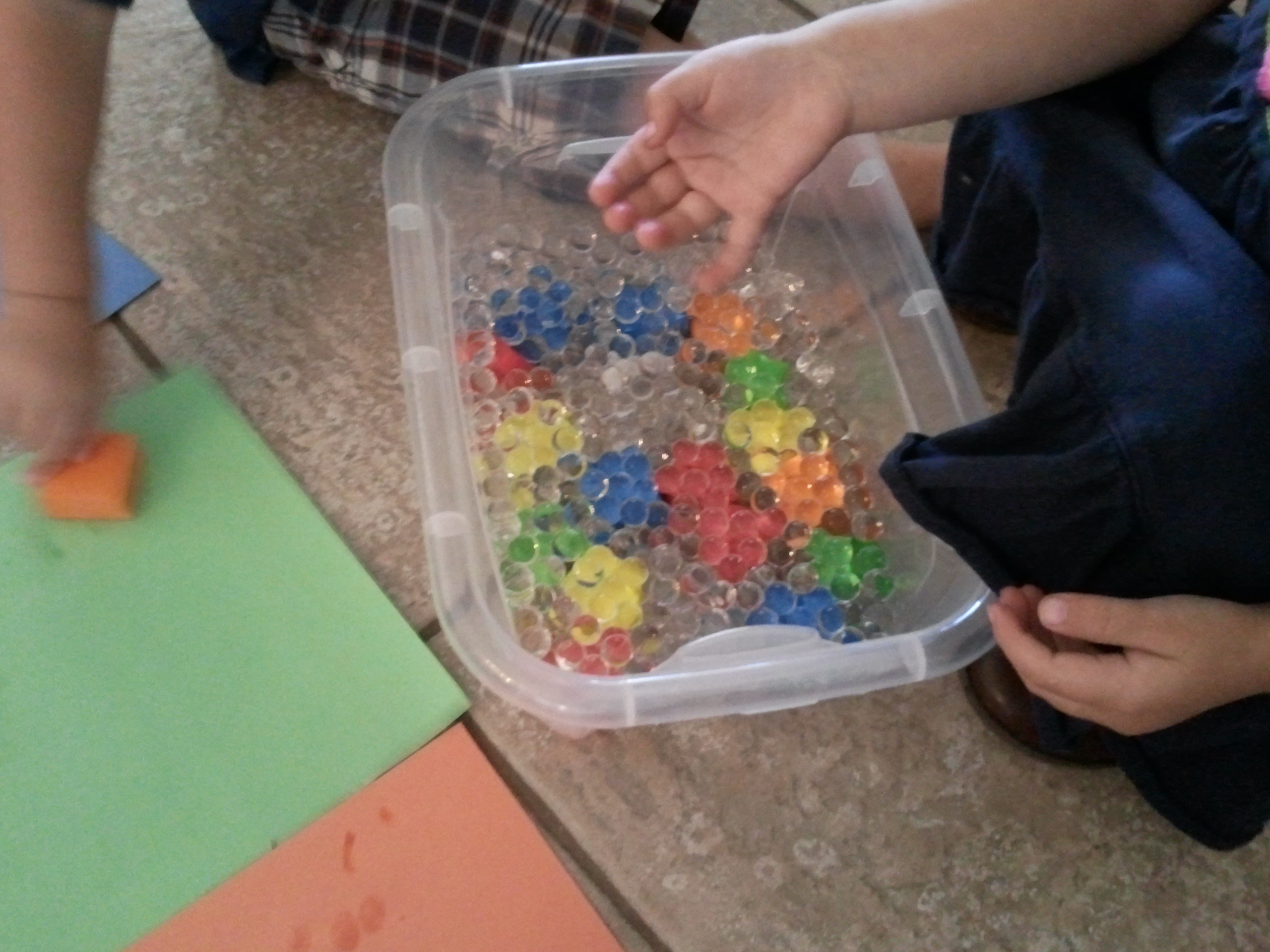
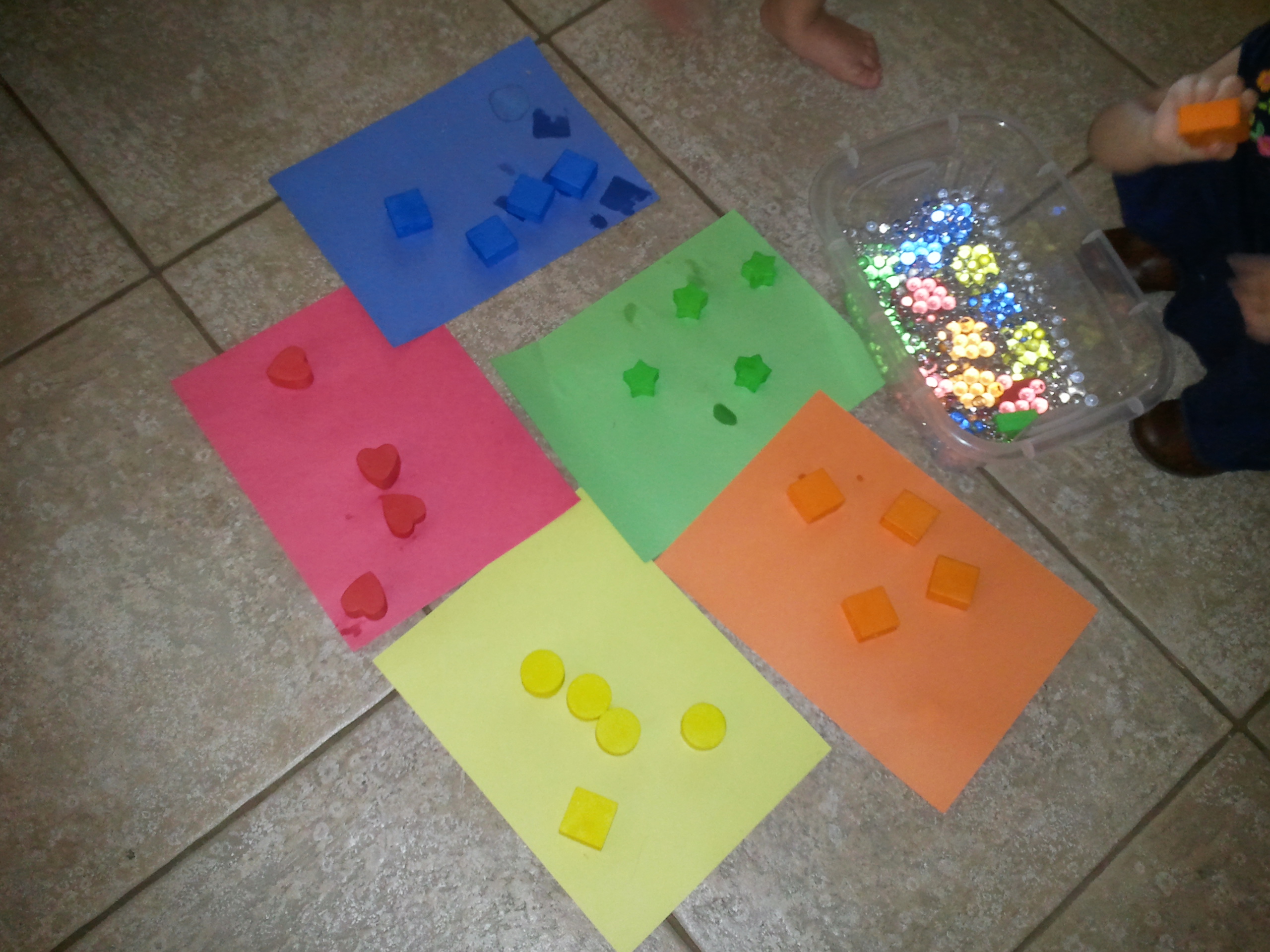
The first activity was on color recognition and matching, which was also a sensory activity.  For this, I used 2 bags of colored foam shapes from Target dollar section, 2 containers of water bead decorative accents from the dollar store (found in the floral section), a plastic shoe box from the dollar store, and 5 pieces of construction paper.  If you aren’t familiar with water beads, according to the container, they are a type of water absorbent polymer that absorbs, stores, and releases water.  They are usually used in plant or floral arrangements.  It also says they are non-toxic, but we kept a close eye on the kids while they played with these to make sure they didn’t put any in their mouths or left any out on the floor.  I put the foam shapes in the plastic shoe box, then poured both containers of water beads in the box.

Then, I laid out construction paper in colors that corresponded with the colors of the foam shapes.  The kids then had to dig through the water beads to get the shapes, identify the color, and match it to the paper of the same color.

This activity was a big hit.  They loved playing with the water beads, and I have to admit, I thought they were pretty cool too.  Of course, for a while, every color was blue but we kept working on it.  I think we will do this next week as well, but pick something different to fill the box with instead of water bead.  I think we might try bird seed to dig through.

Next, I brought our Curious George Matching game.  The night before, I went through and divided the cards by the color of the frames, the red, the yellow, and the blue.  That way there weren’t so many cards all at once.  So, we took one of the three sets and laid them out picture side up.   We tried to take turns, but for the most part, it was just whichever kid found the match first.  At first, they weren’t really sure what to do, this isn’t a game either of us has done much with the kids, but after a couple matches, they caught on.

We took a little time out to play outside.  Both kids were a little sleepy because they didn’t get much of a nap, so it was hard to get them to  focus after playing outside, so the last activity we didn’t push too much.  It was to learn about the letter A.  I created a coloring sheet with an uppercase and lowercase A, along with pictures of things that start with the letter A.  I also brought some items from around the house with the letter A.

I think the first week went really well.  We now know about how long we can keep their attention, so I think next week we’ll just do 2 activities, maybe have a 3rd thing planned if we find we have time or they seem like they want to do something else.

Sandwich “Sushi Rolls”

16 Sep

I’ve been admiring pictures of school lunch bentos for a while now.  My girls aren’t in a full day program that would require a lunch of some kind yet.  However, I do try to be creative with some of their meals I make at home.  We have a dinosaur sandwich cutter that we use on occasion, but I recently came across a new idea –  sandwich “sushi rolls”.  I know that really it’s only sushi if it includes rice, so maybe these would be more like pinwheels.  But, my kids love sushi and since this resembles sushi, that’s what we call it.

I got the original idea on allrecipes.com here: http://allrecipes.com/recipe/peanut-butter-and-jelly-sushi-rolls/detail.aspx.  You start by cutting the crusts off the bread, then use a rolling pin to roll the bread out.  Then, you decide what you want the filling, peanut butter and jelly, turkey and cheese, turkey and lettuce, lots of possibilities.  So far, we have done peanut butter and jelly and chicken lunch meat.

Rolled out bread, peanut butter and jelly spread on

Rolled out bread with chicken lunch meat

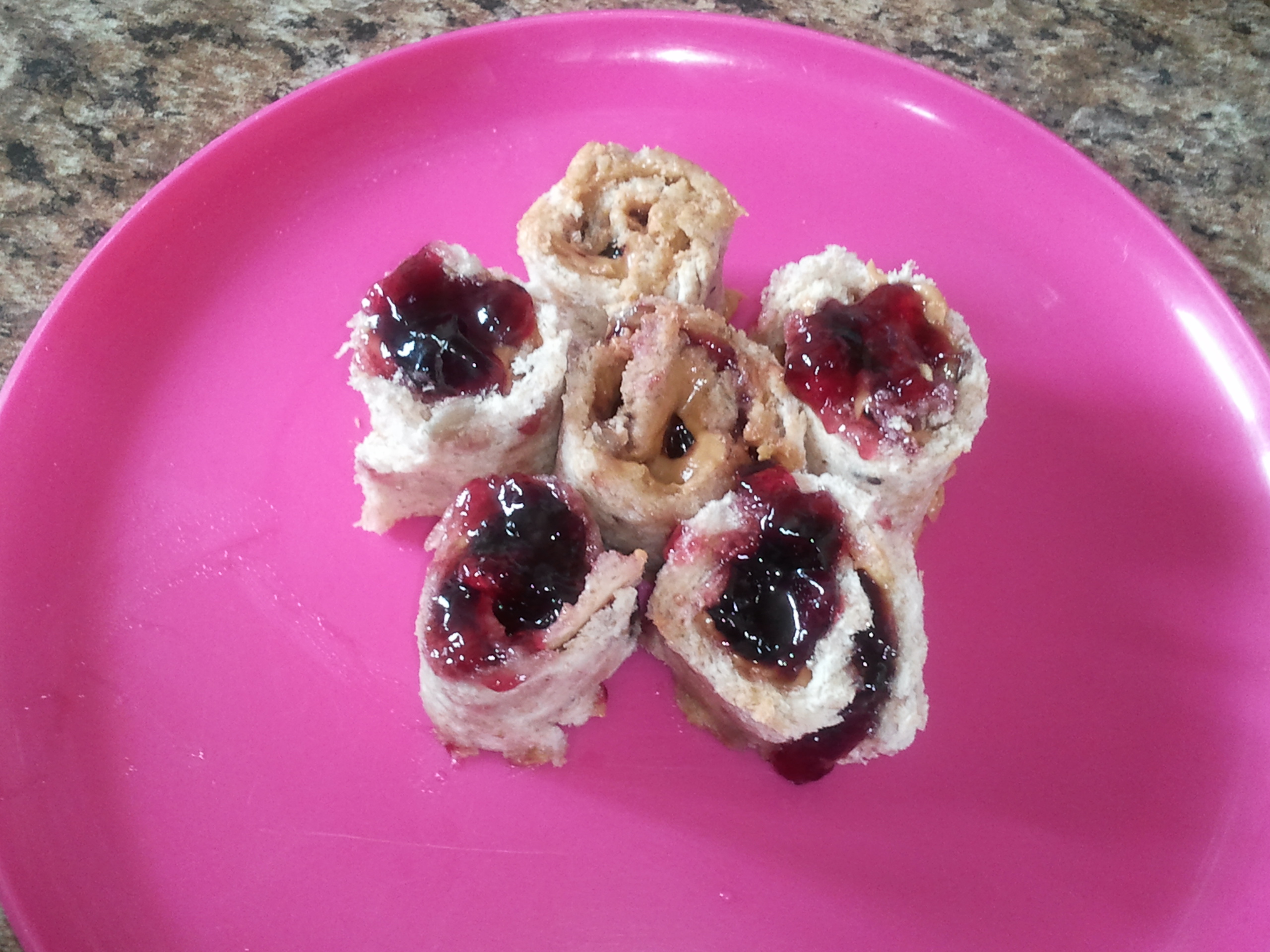
Next, you roll it up, then cut into 3 or 4 pieces.  The bread I am using here is on the small side, it is the organic multi grain bread from Bountiful Baskets, so I cut mine into 3 sections.  I do this twice for each of my kids, so they get 6 rolls each.  I like to arrange the 6 rolls into a flower for my girls.

This does require a little more effort than just a regular sandwich, but my girls get so excited to see something a little different on the plate.  Plus, I’ve found that they will finish off all the rolls, but as a sandwich, they normally don’t finish it all.  I had shared the peanut butter and jelly rolls with my Facebook friends a while back, and one of my friends told me the other day her son wasn’t finishing his sandwich at lunch, so she tried this out and he thought it was great and ate all the rolls.  In fact, some of the other kids wanted the rolls too!

Spinach Manicotti

15 Sep

I still had some spinach left, and I had intended to make spinach artichoke dip, but used some of the ingredients I had on hand for that to make last night’s Radish Dip.  I had wanted to make Stuffed Shells, but the store only had 1 box of shells that was beat up.  The manicotti was right next to it on the shelf, so I decided to make it inside.  The process and end result is pretty much the same, plus, my family really likes manicotti.  Here is how I made it tonight.

Manicotti

1 box manicotti noodles
2 eggs
1 container (15 oz) ricotta cheese
1 cup shredded mozzarella cheese, divided
1/2 cup Parmesan cheese, divided
1 clove garlic, minced
1/2 lb fresh spinach, chopped
1 1/2 tsp basil
1 1/2 tsp oregano
1 jar of pasta sauce

Preheat oven to 350 degrees F.  Cook manicotti according to directions on box.  Drain and cool on a piece of aluminum foil.  Meanwhile, beat eggs in a medium bowl.  Stir in the ricotta, 1/2 cup of the mozzarella, 1/4 cup of the Parmesan, garlic, spinach, basil, and oregano.  Pour 1 cup of the pasta sauce into a 13 x 9 baking dish, or enough to make sure to cover the entire bottom of the dish.  Fill manicotti with the mixture and place in the dish.  Pour the remaining sauce over the filled manicotti, then sprinkle the remaining Parmesan and mozzarella.  Cover tightly with foil.  Bake for 30 minutes.  Remove foil, and bake for another 5-10 minutes, or until sides are bubbling and the cheese is melted.

This didn’t last long in my house tonight!

Radish Dip

14 Sep

My husband loves radishes, and since they were 2 for $1, I bought some on my last trip to the grocery store.  He usually eats them raw, but this time suggested I make the radish dip I had made once before.  Last time it was actually more like a spread, so this time I changed it a little to make it more like a dip.

Radish Dip

What you need:
2 cloves garlic (You may add more or less depending on your taste level.  I actually used 4 cloves tonight and it was a bit much for me)
2 bunches radishes, quartered
8 oz cream cheese, softened
8 oz sour cream*

How to Make it:

Peel the garlic cloves and mince in a food processor.  Add the radishes and mince them as well.  Add in the cream cheese and sour cream, pulse until well blended.  Serve with chips or your favorite veggies.

*Note that if you want this to be more of a spread than a dip, omit the 8 oz sour cream and add another 8 oz of cream cheese.

Kick Off to Savings

14 Sep

Kroger family of stores, including Fry’s Food Stores, has a new promo game out, Kick Off to Savings.  You can play once a day and win up to 2 prizes through 9/24/2011.  I didn’t win anything today, but I will be back to try each day!

Frikadellen and Oven Baked Parmesan Sweet Potato Fries

13 Sep

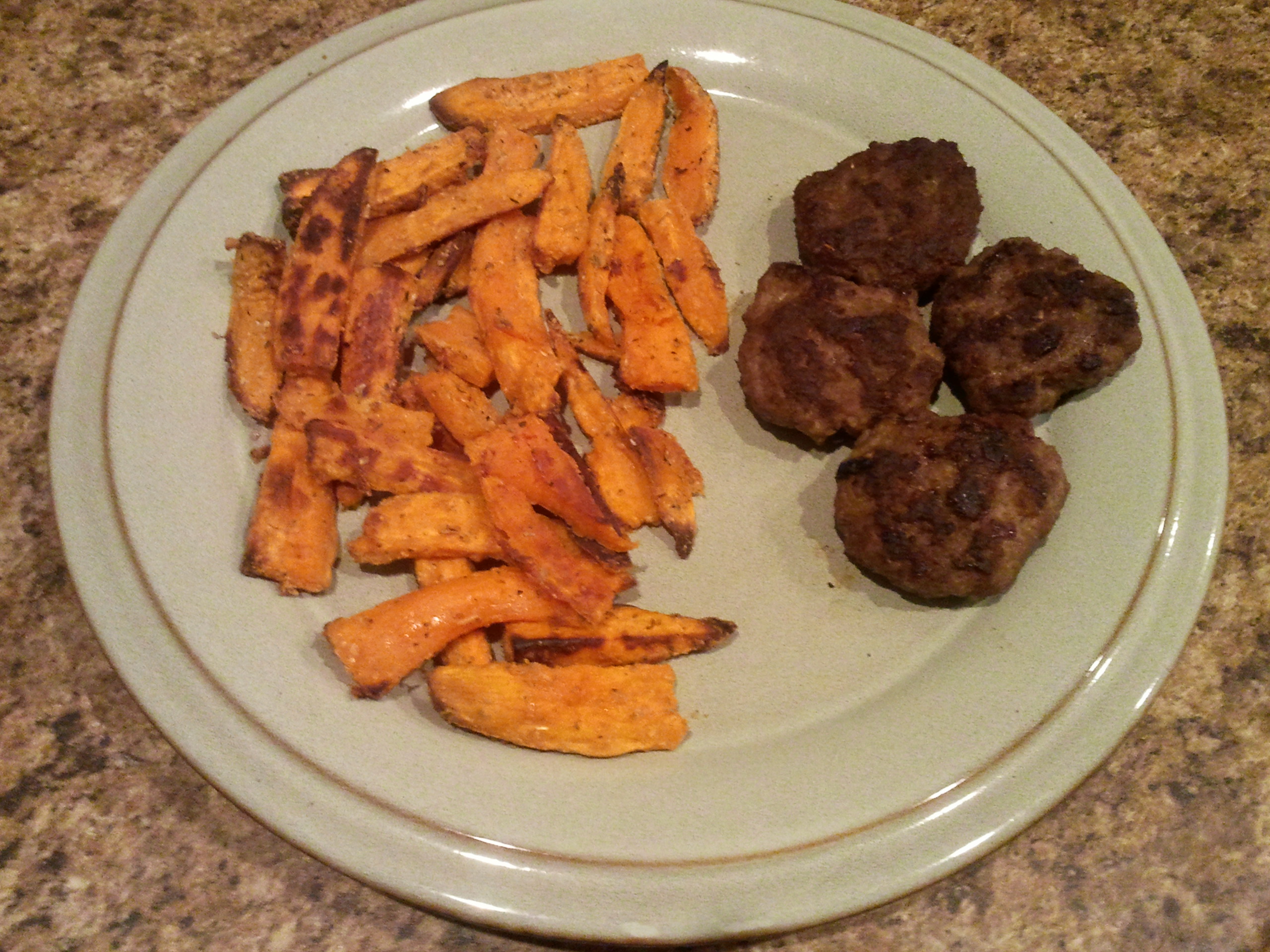
A dear friend of mine (we used to be next door neighbors) introduced me to the Maggi Hackbraten mix packets when we used to trade off nights making dinner.  The packets are really easy, add 1/2 cup water and 1 lb ground beef.  Add 1 Tbsp oil to a skillet, form small patties, and cook until no longer pink in the middle. She would serve them with gravy, with mashed potatoes as a side.  Tonight, I learned from another friend that although the packet shows the patties and says hackbraten, they actually call the patties frikadellen.

I haven’t made these for a while, so I decided it was what we would have for dinner.  We had mashed potatoes recently and I had sweet potatoes from 9/10 Bountiful Baskets, so I decided to make sweet potato fries as a side.  I have a recipe that I have used a couple of times to make these, but decided to try something new tonight.  I had recently seen a recipe for oven baked Parmesan fries, so I decided to try something similar with my sweet potatoes.  Here is how I made them.

Oven Baked Sweet Potato Fries

2 lbs sweet potatoes, washed, peeled
3 Tbsp olive oil
2 tsp Italian blend seasoning
4 Tbsp Parmesan cheese

Preheat oven to 425 degrees F.  Mix together the Italian blend seasoning and Parmesan cheese, set aside.  Cut sweet potatoes into 1/2″ strips, making them all as close to the same size as possible.  Add to a separate bowl.  Pour olive oil over sweet potatoes and toss to coat.  Pour the seasoning mix over the potatoes and again toss to coat.  Line a baking sheet with foil and spray with cooking spray or olive oil.  Pour sweet potatoes into a single layer on the prepared baking sheet.  Cook for 30-45 minutes, turning halfway through, until fries are crispy on the outside (as shown below).

Spanakopita (Spinach Pie)

12 Sep

My mom’s side of the family is Greek, and growing up, we lived in the same town as my grandparents.  And no, not next door like in My Big Fat Greek Wedding.  We did get to see them often, though, and I did get a chance to learn some Greek traditions, attend some services at the Greek Orthodox church, and learn how to cook some traditional Greek dishes.  This also means that most of the dishes I learned how to make, I make from memory or sight, add a handful of this, a little of this, a little of that, until it looks right.  However, I have measured out the way I make spanakopita to my taste, and when I got all the spinach from Bountiful Baskets over the last 2 weeks, I knew I wanted to make this to be able to share how I make it since I get asked a lot.  So, here we go!

Spanakopita

1 roll phyllo dough (You can find this in your grocery’s freezer section with the pies and baked goods)
2 sticks unsalted butter, melted

Filling for spanakopita:
2 lb fresh spinach, chopped, or 3-10oz pkgs frozen chopped spinach, thawed and drained
1 bunch green onions, chopped
1 lb feta cheese, crumbled
4 eggs
1/2 cup fresh parsley, chopped
1 Tbsp dried dill weed

How to put it together:

Preheat oven to 325 F.  Combine the ingredients for the filling and set aside.  Brush bottom and sides of 12″ X 18″ jelly roll pan with melted butter.   Lay phyllo dough in bottom of pan, and brush completely with butter. (Note: Depending on the size of your pan and the size of dough you find, you may need multiple pieces of phyllo dough to cover the bottom of the pan) Repeat the process of laying dough and buttering to create 5-6 layers of dough.  Pour filling over phyllo dough and spread evenly.

Spreading the filling on the phyllo dough

Place a layer of phyllo dough over the filling, again, brushing it completely with butter. Repeat the process of laying dough and buttering until you have 3-4 layers.

Score through top layers of the pastry with a sharp knife. I cut mine in straight lines to make squares, then add diagonal cuts to make triangles.  Pour remaining butter over.

Bake for 1 hour or until pastry is golden brown (see picture at top). Remove to rack and cool for 5 minutes.  Cut and serve!


You can find the cheese version of this, Tiropita, in this post.